What the State Suppressed about Jeff’s Cat*

When Jeffrey Wogenstahl became a suspect in the murder of Amber Garrett his apartment was searched, and testing was performed on various blood traces found there: the only confirmed human blood did not match the blood of the victim. Testing failed to determine whether other blood stains were of animal or human origin.

Jeff believed that some blood could have originated from his cat. He testified that in the week before the victim was reported missing his cat jumped from the seat of the toilet in his bathroom towards the top of the shower curtain, hitting its mouth on the side of the tub. As a result it bled from its mouth. Jeff stated that he wiped blood off the side of the tub and the toilet.

In closing argument, the prosecution ridiculed Jeff’s testimony about the cat and the injury to its mouth:

“Have you ever heard of a cat that falls with such force that it knocks itself unconscious and knocks out a tooth? That story is absolutely ridiculous.”

The prosecution later referred to the animal dismissively as “the psychopathic cat”.

However, the jury was unaware that the State had suppressed a report that would have supported Jeff’s testimony and rebutted the stance of the prosecution. The report† showed that the cat did, indeed, have a chipped tooth. It also stated that a blood sample taken from the cat was delivered to Hamilton County Coroner’s Office; but comment on this blood sample was conspicuously absent from both the Coroner’s Office’s Official Crime Laboratory Report,‡ and from the Serological Research Institute’s report.§

The suppression of this report is of great significance. If the jurors had heard evidence that Jeff was telling the truth about his cat’s accident, some might have been more inclined to believe the rest of Jeff’s testimony. And some may have realized that the state itself was dissembling and untrustworthy. The outcome of the trial could thus have been different.

Jeff’s case is littered with similar instances of suppressed information, any one of which could have altered the jury’s verdict. Jeff has not received justice. He deserves a new trial.

 *Information for this post is taken from: State of Ohio, Plaintiff-Appellee, vs. Jeffrey Wogenstahl, Defendant-Appellant.  Case No. 2016-0423. Appellant Jeffrey Wogenstahl’s Motion to Remand Case to the Trial Court, filed in the Supreme Court of Ohio, October 7, 2016; pages 45 – 47 and page 70. 
† State of Ohio, Plaintiff-Appellee, vs. Jeffrey Wogenstahl, Defendant-Appellant.  Case No. 2016-0423. Volume 2 of Appendix to Appellant Jeffrey Wogenstahl’s Motion to Remand Case to the Trial Court, filed in the Supreme Court of Ohio, October 7, 2016 – Case No. 2016-0423.  Exhibit 73 (pages 80 – 85 of pdf). 
‡State of Ohio, Plaintiff-Appellee, vs. Jeffrey Wogenstahl, Defendant-Appellant.  Case No. 2016-0423. Volume 2 of Appendix to Appellant Jeffrey Wogenstahl’s Motion to Remand Case to the Trial Court, filed in the Supreme Court of Ohio, October 7, 2016 – Case No. 2016-0423.  Exhibit 74 (pages 86 – 96 of pdf).
§ State of Ohio, Plaintiff-Appellee, vs. Jeffrey Wogenstahl, Defendant-Appellant.  Case No. 2016-0423. Volume 2 of Appendix to Appellant Jeffrey Wogenstahl’s Motion to Remand Case to the Trial Court, filed in the Supreme Court of Ohio, October 7, 2016 – Case No. 2016-0423.  Exhibit 75 (pages 97 – 102 of pdf).
Posted in capital punishment, criminal justice, death penalty, Hamilton County, injustice, Jeffrey Wogenstahl, jurors, miscarriages of justice, official misconduct, Ohio, prosecutorial misconduct, USA | Tagged , , , , , , , , , , , , , , , , , , | Leave a comment

A Flawed Statute

Jeffrey Wogenstahl has filed a new petition in the Ohio Supreme Court, claiming that Ohio relied on a flawed statute to allow itself jurisdiction to try him.*

At fault was the statute’s sub-section known as R.C. §2901.11(D); this addressed situations where it was impossible to decide whether a crime had been committed in Ohio or in a different state. In these situations R.C. §2901.11(D) forced courts to presume that Ohio had jurisdiction to try the accused person for the crime.

Jeff argues that this presumption denied him the “due process of law” which is enshrined in the Fourteenth Amendment of the United States Constitution, and also violated the Ohio Constitution’s Due Course of Law Clause. He contends that instead of presuming that it had jurisdiction, the State should have been required to prove that it had jurisdiction.

Justice French has noted† that although the Ohio Supreme Court requires the State to prove that the venue (location) for a trial is appropriate, that Court has yet to consider whether the State should also prove that it has jurisdiction for the trial. As Jeff points out:
“Given that jurisdiction is a prerequisite to venue, failing to require that the State also prove jurisdiction as an element of the offense would make little sense.”

Jeff adds that some Ohio intermediate appellate courts have already deliberated about this, and have decided that jurisdiction is an element of a crime which the State should be obliged to prove.

Jeff maintains that, lacking jurisdiction, his conviction and resultant death sentence are void. He asks the Court to vacate his current execution date, reopen his direct appeal, and vacate his conviction and sentence for the aggravated murder of Amber Garrett.

We wish him success.

*See State of Ohio, Plaintiff, v. Jeffrey Wogenstahl, Defendant. 1995-0042. Jeffrey Wogenstahl’s Motion for Order or Relief Pursuant to Supreme Court Rule of Practice 4.01. In the Supreme Court of Ohio. Filed May 02, 2018. Supreme Court of Ohio database of cases, accessed May 14, 2018.
† The State of Ohio, Appellee v. Wogenstahl, Appellant. Slip Opinion No. 2017-Ohio-6873, French, J., concurring (pages 15 – 17). Supreme Court of Ohio. Decided July 25, 2017. Supreme Court of Ohio database of cases, accessed May 14, 2018.
Posted in capital punishment, criminal justice, death penalty, Jeffrey Wogenstahl, Ohio, USA | Tagged , , , , , , , , , , , , , , , , , | Leave a comment

Hamilton on the Map

Hamilton County, Ohio, is where Jeffrey Wogenstahl was sentenced to death for a murder that he says he did not commit. An interactive map showing all US counties now confirms Sister Helen Prejean’s words:
“Hamilton County kind of stands out.”  

Counties on the interactive map are colored blue if they have produced at least one death sentence between 1991 and 2017 (the darker the blue, the more death sentences). Hamilton County stands out as the darkest blue in Ohio.

Robert Dunham, executive director of the Death Penalty Information Center, believes the approach of local prosecutors is the single biggest factor in whether someone convicted of murder is assigned the death penalty.

What is less clear is whether prosecutorial misconduct has increased death penalty convictions and sentences in the county. Certainly Hamilton is one of two Ohio counties highlighted in 2006 by Jeff Gamso, former legal director for the American Civil Liberties Union of Ohio:
“Prosecutorial misconduct — now you’re talking. Hamilton County and Cuyahoga County (Cleveland) lead the pack there. God knows they lead the pack for sheer number of cases of prosecutorial misconduct…”

So we ask again, was the prosecutorial misconduct experienced by Jeff – and by three other death-sentenced individuals – contained in isolated incidents? Or do those cases reveal systemic problems with death penalty administration in Hamilton County? And is that partly why Hamilton County is such a dark shade of blue?


Posted in capital punishment, criminal justice, death penalty, death sentences, Hamilton County, Jeffrey Wogenstahl, Ohio, prosecutorial misconduct, USA | Tagged , , , , , , , , , , , , , , , , , , | Leave a comment

Not Snatched from her Bed

The prosecutor at Jeffrey Wogenstahl’s trial used his closing argument to impress on the jury that the victim, Amber Garrett, was grabbed from her bed in the middle of the night:
“[W]e know from the evidence that Amber Garrett was in bed early the morning of November 24th, that someone…  removed her without letting her get dressed… Amber’s body was found out in Bright, Indiana still wearing these panties and these clothes that she had worn in the bed on the evening of Saturday, November 23rd.… How about a person who would return to the Garrett household, pick up a half naked Amber Garrett and get her out into his car?” (emphasis added)[i]

As far back as 1996 the Ohio Supreme Court noted:
“[T]he prosecutor’s final closing argument was riddled with improper comments regarding the nature and circumstances of the offense …”
but it allowed Jeff’s conviction to stand.[ii]
 
What no court knew, however, was that the prosecution had suppressed evidence that contradicted its version of events. Under duress, the prosecution finally supplied documents in 2016 showing that when Amber’s body was discovered she was not wearing the night clothes that she dressed in for bed on the Saturday night.[iii] She was, in fact, wearing a red dress that had been given to her[iv] (in 2014 Amber’s friend confirmed that this had been Amber’s dress for church).[v]

The prosecutor also made much of the fact that Amber’s glasses had been left behind; but the state withheld several documents that showed she could manage well without her glasses.

The suppression of these documents is highly significant. If the jurors had learnt that the victim had changed from her night clothes into a dress, and had not been helpless without her glasses, some might have concluded that she was not snatched from her bed in the night. And the outcome of the trial could have been different.

We sincerely hope that Jeff will soon be granted a new trial, where his jurors can see all of the evidence. Justice demands no less.

[i] See State of Ohio v. Jeffrey A. Wogenstahl, 2016-0423, Appellant Jeffrey A. Wogenstahl’s Motion to Remand Case to the Trial Court, filed October 7, 2016. Page 42.
[ii] See The State of Ohio, Appellee, v. Wogenstahl, Appellant, 95-42. Supreme Court of Ohio. Decided  March 6, 1996. Page 9. Web, 26 January, 2015.
[iii] Amber’s mother, Peggy Garrett, told an investigating officer that Amber “had the Loretta Lynn T-shirt on”. See Volume 2 of Appendix to Appellant Jeffrey Wogenstahl’s Motion to Remand Case to the Trial Court, Case No. 2016-0423. Filed in the Supreme Court of Ohio, October 7, 2016. Exhibit 60 (Page 59 of pdf).
Peggy Garrett also told Patrolman Lindsey “that even the nightshirt she slept in was still there [in the house].” See Volume 2 of Appendix to Appellant Jeffrey Wogenstahl’s Motion to Remand Case to the Trial Court, Case No. 2016-0423. Filed in the Supreme Court of Ohio, October 7, 2016. (Exhibit 61, (page 65 of pdf).
[iv] See Volume 2 of Appendix to Appellant Jeffrey Wogenstahl’s Motion to Remand Case to the Trial Court, Case No. 2016-0423. Filed in the Supreme Court of Ohio, October 7, 2016. Exhibits 62 (page 67 of pdf) and 63 (page 68 of pdf).
[v] See Volume 2 of Appendix to Appellant Jeffrey Wogenstahl’s Motion to Remand Case to the Trial Court, Case No. 2016-0423. Filed in the Supreme Court of Ohio, October 7, 2016. Exhibit 43, page 35 of pdf.


Posted in capital punishment, criminal justice, death penalty, Jeffrey Wogenstahl, Ohio, prosecutorial misconduct, USA, wrongful convictions | Tagged , , , , , , , , , , , , , , , , , , | Leave a comment

A Guilty Person Committing More Crimes

We are very pleased that William T. Montgomery is no longer on Ohio’s death row: his death sentence has been commuted to one of life without the possibility of parole. Like Jeffrey Wogenstahl, Montgomery claims he has been wrongly convicted; away from death row he will continue to pursue a “new and fair” trial.

The ripples from wrongful convictions can extend far beyond those wrongly incarcerated or executed: sometimes “when someone is wrongfully convicted, there is a guilty person on the street committing more crimes”. Frank Baumgartner estimates that of the approximately 40,000 wrongful convictions every year in the USA, perhaps a quarter involves the actual perpetrator remaining at large. Some must be murderers who may kill again.

In Jeff’s case there were several suspects who were not investigated and about whom the prosecution withheld evidence (see here and here and here). A further crime or crimes could conceivably have been prevented if the real murderer of Amber Garrett had been identified, convicted and sentenced.

Baumgartner and his wife, Jennifer Thompson, are campaigning to raise public awareness about this aspect of wrongful convictions. They want people to understand that:
“[P]reventing wrongful convictions is not just a way of stopping individual injustices: it’s a way of fighting crime.”
We wish them success with their campaign. And we hope the public demands that Jeff should have a new trial.

Posted in crime, criminal justice, Jeffrey Wogenstahl, murder, Ohio, USA, wrongful convictions | Tagged , , , , , , , , , , , , , , , , , , , | Leave a comment

William T. Montgomery: Cause for Alarm

In Ohio, the machinery of execution continues on its relentless trajectory: no sooner have the death row inmates relaxed a little after the tension surrounding one execution date than another date looms. Next in line is William T. Montgomery, who Jeffrey Wogenstahl has known for many years. Like Jeff, Montgomery has a strong claim of innocence.

In order to prevent Montgomery’s execution, his lawyers have asked the Ohio Adult Parole Authority to recommend clemency. In their petition they list a huge amount of evidence that was suppressed by Montgomery’s prosecution, secured only after a Freedom of Information request.

The petition notes that six Federal judges argued that Montgomery should be granted a new trial because of a suppressed police report that contradicts the state’s theory of the case. Moreover, a recent forensics report confirms this error in the state’s theory; the forensics report was not available when the majority Federal judges blocked a new trial for Montgomery.

The petition continues:
“This case contains a number of troubling elements – no independent, direct evidence of guilt; the Prosecution relied exclusively on the testimony of an accused murderer and child molester who cut a deal; withheld evidence; gross prosecutorial misconduct; and confused, tainted jurors – that taken alone are cause for concern if they resulted in a death verdict. But taken together, these elements are cause for alarm as the execution approaches.”

Amnesty International has issued an Urgent Action appeal for Montgomery; it asks for appeals to be sent to the Ohio Parole Board and to Governor John Kasich. Ohioans to Stop Executions also asks for citizens of Ohio and elsewhere to take action on behalf of William T. Montgomery.

We urge Jeff’s supporters to do so.

Update: Ohio Governor, John Kasich, has commuted William T. Montgomery’s death sentence to life in prison without the possibility of parole, in line with the Ohio Parole Board’s earlier recommendation. This will allow Montgomery to pursue a new trial.


Posted in capital punishment, criminal justice, death penalty, false testimony, injustice, innocence, Jeffrey Wogenstahl, official misconduct, Ohio, prodecutorial misconduct, USA, William T. Montgomery | Tagged , , , , , , , , , , , , , , , , , , , , | 1 Comment

Hamilton County: Vigilance Needed

Hamilton County, where Jeffrey Wogenstahl was tried, imposes the death penalty more frequently than the other counties in Ohio, and has more death row inmates than most of the over 3000 counties that make up the USA. 

Why is this?

The Cincinnati Enquirer suggests the phenomenon derives from the county’s culture, politics and history, but also from “a tough-on-crime mindset that took hold when Cincinnati was a frontier town.”
At that time executions were events that often drew crowds. The same public mentality prevails in the county now, with many of its citizens expecting that violence should be punished with more violence.

The continuing popularity of the death penalty within Hamilton County influences its politicians, who “tout their death penalty credentials”. Local prosecutors take their cue from the public, regularly seeking capital murder charges. Thus Hamilton County is one of only a very small number of outlier counties nationwide where the death penalty seems to be part of the local culture.

The resulting inequity has been highlighted in a report and voiced by Andrew Welsh-Huggins:*
“Your chances of going to death row depend on where you committed the crime.”

Unfair methods used by prosecutors can compound that intrinsic injustice. For instance, Jeff was hugely disadvantaged when his trial prosecutors committed wide-ranging misconduct, and denied him access to extensive, potentially exculpatory and impeaching evidence. Three other death-sentenced individuals† have been awarded new trials because members of the Hamilton County Prosecutor’s Office suppressed exculpatory information. And recently a juror claimed that Hamilton County prosecutors were dishonest and unforthcoming during the sentencing phase of another death penalty trial.

Of course, once an unfairly secured death sentence has been carried out, it cannot be reversed. It is likely that some inmates killed by the state of Ohio were innocent.‡

With so many indicators of an unfair system and unfair practice, the citizens of Hamilton County must clearly be vigilant. Is their death penalty system fit for purpose? Or is it, in fact, injustice of the worst kind masquerading as “justice”?

*Andrew Welsh-Huggins is the author of the book, No Winners here Tonight: Race, Politics and Geography in One of the Country’s Busiest Death Penalty States (Ohio University Press, 2009)
†Derrick Jamison, and Michael Bies and Daryll Gumm. See State of Ohio v. Jeffrey A. Wogenstahl, 2016-0423, Appellant Jeffrey A. Wogenstahl’s Motion to Remand case to the Trial Court, filed October 7, 2016. Pages 9 – 14.
‡See statement by Terry Collins, former Director of the Ohio Department of Correction and Rehabilitation, at 15.00 of video clip:
“I don’t know for a fact that anybody that I ever witnessed be executed was not guilty. But statistical data would say that there’s a good probability of that.”
Posted in capital punishment, death penalty, Hamilton County, Hamilton County Prosecutor's office, injustice, innocence, Jeffrey Wogenstahl, Ohio, prosecutorial misconduct, USA, wrongful convictions | Tagged , , , , , , , , , , , , , , , , , , , | Leave a comment

Governor Kasich Knows

Raymond Tibbetts is due to be executed by the state of Ohio on February 13. Tibbetts suffered “toxic stress” during a traumatic and chaotic childhood, which “negatively affected the development of [his] brain, leading it to become wired in very unhealthy ways”.* The full impact of his childhood was not made plain to his jury during the sentencing phase of his trial, when mitigating factors were considered.

So far, so familiar. Sadly, the executions scheduled by Ohio last year were all for men whose juries were not shown the full extent of their childhood experience, and its impact. This failure did not convince the State of Ohio Adult Parole Authority to recommend clemency for any of them; nor has it done so for Tibbetts.

In Tibbetts’s case, however, one of his jurors, Ross Geiger,† recently found out how much was omitted at Tibbetts’s trial. Geiger is angry that he was
“duped by the system. The state asked me to carry the responsibility for such a decision but withheld information from me that was important.”

He explains the significance of the state’s deception at trial:
“[I]f I had known all the facts, if the prosecutors had been honest and forthcoming about the horrors he and his siblings experienced in the foster care system, and if we had an accurate understanding of the effects of Mr. Tibbetts’ severe drug and alcohol addiction and his improper opioid prescription, I would have voted for life without parole over death.” 

Geiger notes that even his one vote for life without parole would have resulted in Tibbetts avoiding a death sentence.

He has appealed to Governor Kasich to commute the sentence:
“Gov. Kasich… now has proof that [Tibbetts] didn’t receive a fair sentencing. The governor now knows that I would have voted for a life sentence, and Mr. Tibbetts would never have ended up on death row.”

Raymond Tibbetts and Jeffrey Wogenstahl both faced Hamilton County prosecutors at trial. In Jeff’s case no fewer than three jurors have stated that if significant evidence had not been withheld by the prosecution, they might have made different decisions at his trial.

Jeff’s claim of innocence is still being appealed in the courts, but Tibbetts is at the final stage of his request for clemency: only Governor Kasich can now redress the injustice in his case. Life without the possibility of parole is an extremely harsh sentence, but it is what Tibbetts requests. The Governor should accept Geiger’s appeal.

*In Re: RAYMOND TIBBETTS, CCI #A363-178, Minutes of the SPECIAL MEETING of the State of Ohio Adult Parole Authority, held January 17, 2017, page 14, (evidence from Patti Van Eys, licensed psychologist).
†Ross Geiger’s letter to Governor Kasich can be read here.

Update: Governor Kasich has delayed Raymond Tibbetts’s execution from February 13, 2018 to October 17, 2018, so the Ohio Parole Board can consider the concerns of juror, Ross Geiger.

Posted in capital punishment, criminal justice, death penalty, defense attorneys, injustice, Jeffrey Wogenstahl, jurors, miscarriages of justice, Ohio, prodecutorial misconduct, Raymond Tibbetts, USA | Tagged , , , , , , , , , , , , , , , , , , , , , , | 1 Comment

US Death Penalty: Systemic Problems

It is not surprising that public opinion in the USA is increasingly recoiling from the death penalty: the annual Death Penalty Information Center (DPIC) report reveals continuing “systemic problems” in its implementation:

“As use of the death penalty dwindles, one might expect that the few cases that result in death sentences and the even fewer that result in executions would  truly be the most egregious crimes and the most culpable offenders. But events [in 2017] show once again that this is not the case.
“Instead, states appear to be clinging to the death penalty by executing any prisoner unlucky enough to have reached the end of the appeals process without competent representation or rigorous judicial review, and by doing so by any means at their disposal.”

Of the 23 people executed nationwide in 2017, 90% presented significant evidence of mental illness, intellectual disability, brain damage, severe trauma, and/or innocence. Frequently there were substantial concerns that those executed had received inadequate representation and insufficient judicial review. And those executed were subjected to potentially torturous deaths.

Jeffrey Wogenstahl will be pleased that the public is turning against the death penalty; however, he will also be deeply saddened by the abuse of power that promotes the arbitrary state killing of the some of the most vulnerable in society.

We hope that growing public revulsion will soon kill off the US death penalty for good. It is time for the USA to join the vast majority of industrialized countries that condemn capital punishment. It is time for this scandal to end.

Posted in capital punishment, criminal justice, death penalty, executions, Jeffrey Wogenstahl, Ohio, USA | Tagged , , , , , , , , , , , , , , , , , , | Leave a comment

A Tremendous Error

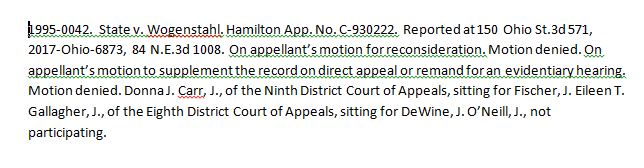
The Ohio Supreme Court has again rejected Jeffrey Wogenstahl’s claim that Ohio did not have jurisdiction to try him. The court’s decision,[i] announced last month, is mystifying. The state did not file a rebuttal of the points made by Jeff when he asked the court to reconsider; nor did the court explain its unwillingness to do so. And yet no less a person than the court’s Chief Justice earlier wrote persuasively of Jeff’s claim:

“[F]ailing to ensure that this state has jurisdiction in such a case is a tremendous error and is a disservice to the citizens of Ohio and the victims of violent crime.”[ii]

In Jeff’s request for reconsideration he explains the State’s obligations at trial:
‘[T]he State must prove beyond a reasonable doubt… that either the injuries causing the death or the death itself occurred in Ohio[, o]r… that “the evidence is insufficient to say with confidence in which state the murder occurred ”.’[iii]

The State fulfilled neither of these obligations when Jeff was tried. In reviewing his case last year, the majority judges attempted to demonstrate that the second point had been fulfilled at the time of the trial; but they offered no record evidence to support their speculation that the prosecution’s position allowed for Jeff turning back into Ohio via one of two side roads from the main Ohio-Indiana road.[iv] In any event, as Chief Justice O’Connor explained in her July 2017 dissent, the road layout and the timeline presented by the state at trial made it virtually impossible for the majority’s hypothetical scenario to have occurred.[v]

The majority similarly engaged in improper speculation, unsupported by evidence, in concluding that the fatal injuries could have been inflicted while the victim was still in Ohio. Moreover, the timeline established by the prosecution at trial, as well as the forensic evidence in Jeff’s apartment and car, suggest that this theory, too, is simply wrong.[vi]

Last month’s court decision matters to Jeff because the rules of the US death penalty system and the “materiality” rule make it extremely difficult for him to be granted a new trial on the basis of his innocence.

The Ohio Supreme Court’s decision will now be appealed in a federal court. We trust that the judges there will recognize and repair the injustice created by Ohio.

We wish Jeff a happy and peaceful 2018.

[i] The Supreme Court of Ohio 12/20/2017 Case Announcements, 2017-Ohio-9111. Page 14. Reconsideration of Prior Decisions. 1995-0042. State v. Wogenstahl. Hamilton App. No. C-930222.  
[ii] State v. Wogenstahl, 150 Ohio St.3d 571, 2017-Ohio-6873, (No. 1995-0042—Submitted April 4, 2017—Decided July 25, 2017.) REOPENED APPEAL from the Court of Appeals for Hamilton County, No. C-930222. O’CONNOR, C.J., dissenting, at {¶ 54}. 
[iii] Appellant Jeffrey Wogenstahl’s Motion for Rehearing and/or Reconsideration, Case No. 1995-0042, filed in the Supreme Court of Ohio, August 4 2017. Page 5 (Page 6 of pdf). 
[iv] Appellant Jeffrey Wogenstahl’s Motion for Rehearing and/or Reconsideration, Case No. 1995-0042, filed in the Supreme Court of Ohio, August 4 2017. Pages  8 – 9 (pages 9 – 10 of pdf). 
[v] State v. Wogenstahl, 150 Ohio St.3d 571, 2017-Ohio-6873, (No. 1995-0042—Submitted April 4, 2017—Decided July 25, 2017.) REOPENED APPEAL from the Court of Appeals for Hamilton County, No. C-930222. O’CONNOR, C.J., dissenting, at {¶ 68} and {¶ 69}. 
[vi] Appellant Jeffrey Wogenstahl’s Motion for Rehearing and/or Reconsideration, Case No. 1995-0042, filed in the Supreme Court of Ohio, August 4 2017. Page 7 (Page 8 of pdf). 
Posted in capital punishment, criminal justice, death penalty, Indiana, innocence, Jeffrey Wogenstahl, miscarriages of justice, Ohio, USA, wrongful convictions | Tagged , , , , , , , , , , , , , , , , , , | Leave a comment