What the State Suppressed about Eric Horn

Suppressed police records relating to Jeffrey Wogenstahl’s case reveal much about Eric Horn (brother of the victim, Amber Garrett).

The records show that two weeks before Amber disappeared, Horn said that he hated his sister and wished she was dead;* another document notes that he was seen with a knife**.

Moreover, Horn had been arrested for trafficking in marijuana six months before Jeff’s trial. The prosecution suppressed not only this, but also a subsequent reduction in the charges that Horn faced. Without any hearing or paperwork, his felony was reduced to a misdemeanor, for which he was fined and placed on probation. A month before Jeff’s trial, Horn’s probation was ended anonymously, by a visiting judge. ***

The suppressed records also impeach the testimony that Horn gave at Jeff’s trial. Horn told the court that he left his mother’s apartment only between 3.00 and 3.30 on November 24, 1991. However, the records include both a witness statement placing him away from the apartment at 2.30 a.m; and a report that he left the apartment at 3.30 and returned at 5.00.****

The prosecution likewise suppressed Horn’s inconsistent statements concerning Jeff’s clothing. At the trial, Horn identified a brown leather jacket (given significance by the prosecution) as the one worn by Jeff; however, this conflicts with records in which Horn describes both “a wine colored windbreaker type jacket” and (under hypnosis), “Possibly wht Sweater +jeans”. . . .†

Also suppressed was the report of Horn’s polygraph examination, which shows “significant emotional and physiological disturbances indicative of deception”.

As with Peggy Garrett’s testimony, the state suppressed information that Horn’s testimony resulted from unauthorized hypnosis, which rendered it inadmissible in its entirety.§

The list of information suppressed is shocking, and highly relevant. In 2015, three of the jurors at Jeff’s trial separately indicated that the suppressed information about Eric Horn would have been very important to them, and could have changed their verdict.‖

Jeff deserves a new trial.
* See Volume 1 of Appendix to Appellant Jeffrey Wogenstahl’s Motion to Remand Case to the Trial Court, filed in the Supreme Court of Ohio, October 7, 2016 – Case No. 2016-0423; p. 135.  
** See Volume 1 of Appendix to Appellant Jeffrey Wogenstahl’s Motion to Remand Case to the Trial Court, filed in the Supreme Court of Ohio, October 7, 2016 – Case No. 2016-0423; p. 133. 
*** See Appellant Jeffrey Wogenstahl’s Motion to Remand Case to the Trial Court, filed in the Supreme Court of Ohio, October 7, 2016 – Case No. 2016-0423; pp 28 – 29. 
**** See Volume 1 of Appendix to Appellant Jeffrey Wogenstahl’s Motion to Remand Case to the Trial Court, filed in the Supreme Court of Ohio, October 7, 2016 – Case No. 2016-0423; pp. 136 and p. 138. 
† See Appellant Jeffrey Wogenstahl’s Motion to Remand Case to the Trial Court, filed in the Supreme Court of Ohio, October 7, 2016 – Case No. 2016-0423; pp 27 – 28. 
‡ See Volume 1 of Appendix to Appellant Jeffrey Wogenstahl’s Motion to Remand Case to the Trial Court, filed in the Supreme Court of Ohio, October 7, 2016 – Case No. 2016-0423; p. 128. 
§ See Appellant Jeffrey Wogenstahl’s Motion to Remand Case to the Trial Court, filed in the Supreme Court of Ohio, October 7, 2016 – Case No. 2016-0423; pp. 24 – 25. 
‖ See Appellant Jeffrey Wogenstahl’s Motion to Remand Case to the Trial Court, filed in the Supreme Court of Ohio, October 7, 2016 – Case No. 2016-0423; pp. 58 – 59. 
Posted in capital punishment, criminal justice, death penalty, Eric Horn, Hamilton County, Jeffrey Wogenstahl, Ohio, prosecutor misconduct, prosecutorial misconduct, USA | Tagged , , , , , , , , , , , , , , , , , , , | 3 Comments

Executions Halted

For now, Ohio cannot perform its scheduled executions: Judge Merz, a federal magistrate judge, has ruled against its proposed lethal injection protocol.  The ruling has been appealed by the state. 

In his federal court testimony Gary Mohr, Director of the Ohio Department of Rehabilitation and Correction (ODRC),  stated* he had adopted Ohio’s current protocol because he believed the US Supreme Court had approved it in the 2015 Glossip v. Gross ruling out of Oklahoma. Merz explains that Mohr’s belief was erroneous: Ohio must start afresh with assessing the protocol. 

Much of the testimony heard by the court was about midazolam, the first drug in the Ohio protocol. Five experts testified about its likely effects, often giving conflicting opinions. Merz notes that all of them agreed midazolam would prevent the condemned inmate from forming memories of his pain. The judge does not find this a convincing argument for approving the drug:
“That does not mean the pain was not inflicted and the Supreme Court has yet to tell us that inflicted pain that is not remembered does not count as severe pain for Eighth Amendment purposes.”**

Noting also that several states, including Ohio, have abandoned midazolam after it caused problems with executions, Merz concludes:***
“[U]se of midazolam as the first drug in Ohio’s present three-drug protocol will create a “substantial risk of serious harm” or an ”objectively intolerable risk of harm”.

Merz also finds that Ohio must not use potassium chloride or a paralytic agent, because the state told a court previously that it would not use such drugs during executions.****

Jeffrey Wogenstahl is not in immediate danger of execution, despite his name still appearing on the ODCR scheduled execution list. Jeff’s execution date has been stayed by the Ohio Supreme Court, which has also allowed him to follow a direct appeals process if necessary (read more here).

Nonetheless, Merz’s ruling is appreciated by Jeff: he will be spared the horror of seeing his fellow inmates being moved prior to execution. We welcome this news.

*Ohio Execution Protocol Litigation, Case: 2:11-cv-01016-EAS-MRM Doc #: 948, United States District Court for the Southern District of Ohio Eastern Division at Columbus, Filed: 01/26/17, pages 27 – 28 (see here.)
**Ohio Execution Protocol Litigation, Case: 2:11-cv-01016-EAS-MRM Doc #: 948, United States District Court for the Southern District of Ohio Eastern Division at Columbus, Filed: 01/26/17, page 104 (see here.)
***Ohio Execution Protocol Litigation, Case: 2:11-cv-01016-EAS-MRM Doc #: 948, United States District Court for the Southern District of Ohio Eastern Division at Columbus, Filed: 01/26/17, page 105 (see here.)
****Ohio Execution Protocol Litigation, Case: 2:11-cv-01016-EAS-MRM Doc #: 948, United States District Court for the Southern District of Ohio Eastern Division at Columbus, Filed: 01/26/17, page 114 (see here.)
Posted in capital punishment, criminal justice, death penalty, executions, Jeffrey Wogenstahl, lethal-injection protocol, midazolam, Ohio, USA | Tagged , , , , , , , , , , , , , , , , , , , | Leave a comment

Oral Argument: April 4, 2017

Tuesday, April 4, 2017 will be an important day for Jeffrey Wogenstahl. Oral argument has been scheduled for that day,* to consider whether his Ohio trial court lacked jurisdiction to try him (Jeff has a strong case that because the state decided the victim was killed in the state of Indiana, he should have been tried in Indiana).

If the Ohio Supreme Court agrees with Jeff, it could declare his trial court’s decision void.** He could then be granted a new trial in Indiana.

Jeff has always claimed innocence: a new trial would allow him to pursue this claim. In Indiana he would avoid the Ohio prosecutors who committed misconduct during his 1993 trial. And he is now in possession of significant, potentially exculpatory information that was withheld from him and the jury during his original trial.

We trust the oral argument will convince the judges. We trust Jeff will be granted a new trial in Indiana.

*See the Supreme Court of Ohio Case Information, 1995-0042: State of Ohio v. Jeffrey A. Wogenstahl, entry for 01/24/2017). 
**See Merit Brief of Appellant Jeffrey Wogenstahl, filed August 1, 2016 (P. 11 of whole document).
Posted in capital punishment, criminal justice, death penalty, Indiana, injustice, innocence, Jeffrey Wogenstahl, jurisdiction, Ohio, oral argument, USA, wrongful conviction | Tagged , , , , , , , , , , , , , , , , , , , | Leave a comment

Peggy Garrett: Impeached Testimony

Before her death Amber Garrett, the 10 year-old victim in Jeffrey Wogenstahl’s case, was suffering at the hands of her mother. Suppressed police records contain Amber’s school journal entry*, written days before her murder, in which she described a vicious attack by her mother, Peggy:
“Just yesterday before I came to school my mom beat me she was punching me in the back. She just would not stop.”

Another page** describes an argument between mother and daughter, during which Peggy hit Amber on the head three times; this occurred the night before Amber went missing.

Other reports from the suppressed file state that Amber sometimes had to stay elsewhere because she was not allowed into the family apartment;*** and that she talked of running away.†

The picture built by these records belies the testimony given by Peggy at Jeff’s trial, in which she claimed that she and Amber were very close.‡

Peggy’s claim of a good relationship with Amber was only one part of her testimony: several other of her statements are similarly impeached by the suppressed police documents§. Moreover, the state suppressed information that Peggy’s testimony resulted from unauthorized hypnosis, which rendered it inadmissible in its entirety.‖

The suppressed police file contains a good deal of other information that could have altered the verdict of Jeff’s trial.

The list of state malpractice seems endless: prosecutor misconduct, inadequate forensics, poor witness identification procedures, and the suppression of highly relevant, impeaching evidence. Jeff deserves a new trial.

Update: For more about Peggy Garrett in the suppressed police file, see Other Suspects: Extensive Suppression of Evidence.

*See Volume 1 of Appendix to Appellant Jeffrey Wogenstahl’s Motion to Remand Case to the Trial Court, filed in the Supreme Court of Ohio, October 7, 2016 – Case No. 2016-0423; P. 95.
** See Volume 1 of Appendix to Appellant Jeffrey Wogenstahl’s Motion to Remand Case to the Trial Court, filed in the Supreme Court of Ohio, October 7, 2016 – Case No. 2016-0423; P. 98.
*** See Volume 1 of Appendix to Appellant Jeffrey Wogenstahl’s Motion to Remand Case to the Trial Court, filed in the Supreme Court of Ohio, October 7, 2016 – Case No. 2016-0423; P. 99.
†See Volume 1 of Appendix to Appellant Jeffrey Wogenstahl’s Motion to Remand Case to the Trial Court, filed in the Supreme Court of Ohio, October 7, 2016 – Case No. 2016-0423; P.100.
See Appellant Jeffrey Wogenstahl’s Motion to Remand Case to the Trial Court, filed in the Supreme Court of Ohio, October 7, 2016 – Case No. 2016-0423; P. 19.
§See Appellant Jeffrey Wogenstahl’s Motion to Remand Case to the Trial Court, filed in the Supreme Court of Ohio, October 7, 2016 – Case No. 2016-0423; Pp 18 – 24.
‖See Appellant Jeffrey Wogenstahl’s Motion to Remand Case to the Trial Court, filed in the Supreme Court of Ohio, October 7, 2016 – Case No. 2016-0423; Pp 16 – 18.
Posted in capital punishment, criminal justice, death penalty, Jeffrey Wogenstahl, Ohio, testimony, USA | Tagged , , , , , , , , , , , , , , , , , | 2 Comments

Burning at the Stake

Ohio has introduced a lethal injection protocol as cruel and unusual as “burning at the stake, crucifixion, and breaking on the wheel” (examples of punishments which the US constitution forbids as cruel and unusual). The state is emboldened by a shocking US Supreme Court ruling out of Oklahoma, which allowed midazolam as an anesthetic for executions, even though the drug is not approved as an anesthetic for surgery.

In a dissent to the Oklahoma ruling, Justice Sotomayor explained why the majority justices were wrong to base their decision on the testimony of that state’s witness, Dr Evans:
‘Dr Evans’ testimony… [is] entirely unsupported by any study or third-party source,… inconsistent with the scientific understanding of midazolam’s properties, and apparently premised on basic logical errors… [The court’s ruling] leaves petitioners exposed to what may well be the chemical equivalent of being burned at the stake.’*

This barbaric ruling is being embraced by other US states, including Ohio.

To make things worse, Ohio wants the provenance of lethal injection drugs to remain secret, thus preventing inmates from challenging the use of those drugs in any meaningful way.

USA citizens are accustomed to hearing condemnation for brutish and uncivilized punishments in faraway lands: cutting off the hand of a thief is rightly deplored. Unless a hearing held this week prevents it, Ohioans may soon be made responsible for a punishment that is more brutal still.

*Glossip v. Gross, June 29, 2015, Justice Sotomayor’s dissent, pp 97 – 111
Posted in capital punishment, criminal justice, death penalty, execution drugs, executions, Glossip v. Gross, Jeffrey Wogenstahl, lethal-injection drugs, midazolam | Tagged , , , , , , , , , , , , , , , , , , | Leave a comment

Another Critical Report

It is painful to read the 2015 Forensic Pathology report* about Jeffrey Wogenstahl’s case, as it focuses on the brutal murder of a child, and the disposal of her body. The report, submitted by Carl Schmidt in February 2015, is contained in a motion now before the Ohio Supreme Court. It highlights yet again how Jeff’s prosecutors misinterpreted the evidence from the crime.

The prosecution maintained that Jeff kidnapped Amber Garrett, transported her in his car, murdered her, and left her to die in a wooded area at least four miles inside Indiana. They suggested that Jeff’s car could have been the location of the murder.

Schmidt, however, believes this is extremely unlikely:
“It is practically impossible that the victim was in the car when [her] injuries were sustained… The injuries to the head were caused when the head was supported against a firm surface, such as the ground…  [The victim’s] injuries could not have occurred while [she] was sitting up…”

Schmidt also dismisses the prosecution’s contention that Jeff’s car was used for transporting the body:
It would be extremely hard to thoroughly clean up [the] blood and fluid, particularly in a small space, such as a car that includes absorbent materials like carpeting.”

And Schmidt is cautious about the prosecutors’ suggestion that the car jack handle from Jeff’s car could have been the blunt instrument used for the crime:
“It is not possible to ascertain what kind of instrument was used to inflict the blunt injuries.”

Schmidt’s report is just one of three professional reports** about Jeff’s case that are included in a motion before the Ohio Supreme Court; all three reports point to serious deficiencies in the investigation of the case. On top of known prosecutor misconduct and the withholding of significant evidence, this is highly disturbing. Jeff deserves a new trial; we hope that 2017 will be the year when this is granted.

We wish Jeff a peaceful holiday season.

*See Volume 2 of Appendix to Appellant Jeffrey Wogenstahl’s Motion to Remand Case to the Trial Court, filed in the Supreme Court of Ohio, October 7, 2016 – Case No. 2016-0423; Pp 116 – 119.

**The other two reports are Gary Rini’s 2015 report on forensics (see more here), / and Dr Harvey Shulman’s 2015 report on eyewitness identification (see more here). 

Posted in capital punishment, criminal justice, death row, forensic pathology, injustice, innocence, Jeffrey Wogenstahl, Ohio, USA, wrongful conviction | Tagged , , , , , , , , , , , , , , , | Leave a comment

Likelihood of False Identification

Dr. Harvey G. Shulman, PhD, an expert in eyewitness behavior and accuracy, has highlighted flawed police procedures and other factors that increased the chances of false identification by the eyewitnesses who testified at Jeffrey Wogenstahl’s trial.

Shulman’s report is contained in a motion* that is now being considered by the Ohio Supreme Court. Significantly, he notes:
“In known cases of false conviction… it has been reported that mistaken eyewitness testimony was a major contributing factor in over 80% of cases.”

 Shulman remarks that when witnesses Kathy Roth and Brian Noel saw a person whom they later identified as Jeff, their visibility was impeded by poor lighting and viewing angle and limited time; these factors, Shulman says, would have made it “extremely challenging to form a durable, detailed memory”.

The formal identification of Jeff by the witnesses also concerns Shulman. For instance, he observes that Noel apparently used a ‘best match’ strategy at the physical lineup where he identified Jeff (Noel said, “closest one out of that bunch, he’s the only one that fits that description all that much”). According to Shulman, such a ‘best match’ strategy is liable to lead to false identification.

Shulman finds Roth’s identification of Jeff in a photo array even more problematic. Roth failed to identify Jeff soon after the crime, and made only a tentative identification eleven months later, at which point the administrator unfairly presented a second picture of Jeff. This constituted “a suggestive single candidate display that would have been influenced by the immediately preceding photos”. Shulman concludes,
“[T]he photo of Wogenstahl may have been falsely identified because his appearance in the recent photo array made him seem familiar.”

Shulman also states that eyewitnesses should be told that the perpetrator may not be present in a line-up. This procedure does not seem to have been followed in the case of eyewitness Vicky Mozena, who was told to circle the photo that she thought was “the gentleman that came in that night”.

Witnesses Mozena and Roth had both seen Jeff before they undertook the identification process (Mozena had seen him in her workplace before the crime date, and Roth saw him on TV soon after the crime). Shulman explains that prior encounters or media exposure can distort witnesses’ memory of what they saw around the time of the crime.

All three witnesses expressed their court testimony with confidence. Shulman points out that jurors tend to wrongly believe that confidence indicates accuracy; whereas, in fact, confidence is influenced by many factors that arise after the memory is formed. He adds that the courtroom scenario is biased against the defendant and socially coercive to the witness.

Shulman believes that if an expert on Eyewitness Identification had explained to the jury the potential for false identification in Jeff’s case, this might have altered the credence given by the jurors to the eyewitness testimony.

Yet again, this is compelling evidence for Jeff to be granted a new trial. We trust the court agrees.

*See Volume 2 of Appendix to Appellant Jeffrey Wogenstahl’s Motion to Remand Case to the Trial Court, filed in the Supreme Court of Ohio, October 7, 2016 – Case No. 2016-0423; Pp 111 -113.
Posted in capital punishment, criminal justice, death penalty, eyewitness identification, eyewitness misidentification, Jeffrey Wogenstahl, Ohio, USA | Tagged , , , , , , , , , , , , , , , , , , , | 1 Comment

President Trump

President Obama has misgivings about the application of the death penalty; President Trump will have no such qualms.

In 1989 Trump funded full page ads in four New York newspapers, calling for the return of the death penalty. The ads referred obliquely to a Central Park rape case, in which 5 black and Latino teenagers were accused of assaulting and raping a white woman. The rhetoric helped to fuel a lynch mob mentality about the case.

Trump justified his extrajudicial methods with the disturbing retort,
“Maybe hate is what we need.”

The 5 young teenagers had been interrogated over many hours without food, drink or sleep, with no lawyers and often no parents present; they were terrified. Naively believing they would be allowed home if they submitted, four gave way to the pressure: they said they had been at the crime scene, but blamed others for the rape.

The four statements were inconsistent and lacked credibility, but were enough to convict them. The “Central Park Five” were sentenced to between 8 and 13 years in prison.

In 2002 a serial rapist confessed to the crime, and DNA evidence confirmed his guilt. The sentences of the five young men were vacated.

As recently as last month, Trump reiterated his belief in the men’s guilt, refusing to credit the evidence to the contrary.

As Amy Goodman commented,

“[T]he police were so intent on getting the [Central Park Five], that [the serial rapist], who was committing these crimes at the time, who was sent to prison for these crimes, was never in any way linked, because of their blindness in this case.”

Jeffrey Wogenstahl must be only too aware of this kind of blindness: in his case, too, the evidence suggests that the police limited their investigation to Jeff, ignoring the many indications that somebody else was the murderer.

Trump will take his attitudes to the presidency, affecting his choice of Supreme Court justice – or justices – and possibly relaxing the stance of the FDA towards imported lethal injection drugs. The President-elect has advocated the torture of waterboarding, so is unlikely to be troubled by the prospect of torturous, botched executions. Under President Trump, the death penalty, riddled as it is with racism, inconsistency and injustice, could see a resurgence. It is a chilling prospect.

Posted in capital punishment, criminal justice, death penalty, Donald Trump, Jeffrey Wogenstahl, Ohio, USA | Tagged , , , , , , , , , , , , , , , , , | Leave a comment

Forensics: a Deeply Troublesome Case

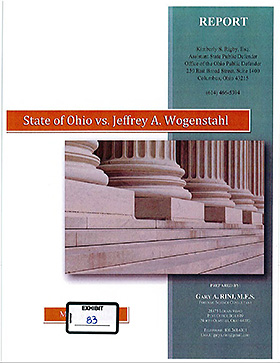
forensics-report-march-13-2015-front-page-30

Alongside potentially exculpatory and impeaching evidence that had been retrieved earlier this year, three professional reports about Jeffrey Wogenstahl’s case were filed with the Ohio Supreme Court last month. In one, Gary Rini M.F.S. examines witness testimony and documents from Jeff’s case, and gives his opinions about the original investigation of forensic evidence in this case.* 

Rini condemns the approach taken by those investigating the crime:
“The procedures used by crime scene investigators did not meet the standards reflected in contemporary crime scene-related texts… regarding the planning, searching, documentation, protection and evidence collection of homicide-related scenes.”

He pinpoints deficiencies in the following areas:

“-[T]here was not a demonstrated plan to search the scene in a structured manner which may have resulted in the failure to discover evidence at the scene;
-Failure to limit and control access to the scene to only those needed to process the scene increased the possibility of the loss, destruction, or contamination of potential evidence by curious on-lookers,
-Failure to employ the services of, or seek the advice of forensic specialists (e.g. bloodstain pattern analysts, forensic botanists, forensic geologists or forensic entomologists) at the time of the crime, could have contributed to the potential loss of associated forensic evidence which could have been discovered through the use or consultation with those specialists;
-Failure to provide sufficient scene photographs… could have resulted in the lost opportunity to discover additional evidence, or limit an objective crime scene analysis by an independent third-party expert.

He makes further pertinent observations, including:

“-[I]t is not uncommon for inexperienced investigators to misinterpret the results of certain presumptive tests for blood.
-Bleach will not prevent the scientists from locating blood.
-Due to the lack of the volume of blood one would expect inside a closed space (such as a vehicle) that would have been generated from the victim’s injuries, and due to the lack of any transfer evidence of the murder weapon onto the interior of the vehicle, it is highly unlikely that the victim was killed or transported in the suspect’s vehicle.
-The lack of detection of blood, or indications of blood clean-up within Wogenstahl’s apartment make it highly unlikely that the victim was murdered within Wogenstahl’s apartment.
-Any hair that may have been found may well have been deposited as a result of cross-contamination during the handling of the evidence by the various individuals who had custody of the material during the course of the examination and/ or testing of the clothing evidence.
-Had photographs [of the scene around and below the victim’s body] been taken, it would have enabled an independent third party bloodstain pattern analyst an opportunity to assess the degree of blood loss and distribution patterns of the blood in order to support or refute the determination of the outdoor scene as the location of the physical assault that led to the victim’s death.
The State’s contention that the victim was murdered elsewhere, or in Wogenstahl’s car, which was then used to transport the victim to the scene, is not supported by the physical evidence in the car, at the scene or on the victim.

 -My informed opinion is that the victim was killed very close to the dump site, then dragged… and placed where she was discovered.”

Rini shares his huge misgivings about the part played by the substandard investigation in securing Jeff’s conviction:

“In my nearly forty years of experience in law enforcement and forensic investigation, it is my opinion that the investigation of this case was so deficient in its thoroughness and adherence to established procedures of professional competence that it rates in the top 10% of the most troublesome cases that I have reviewed, or personally have been involved with, since I began my law enforcement career in 1975.”  

Any poorly conducted forensic investigation should raise concern about the case to which it relates; but where that poor investigation overlies extensive prosecutorial misconduct and the withholding of significant evidence from the jury, the concern must be compounded.  We trust the judges of the Ohio Supreme Court will agree. We trust they will grant Jeff a new trial.

*See *Volume 2 of Appendix to Appellant Jeffrey Wogenstahl’s Motion to Remand Case to the Trial Court, filed in the Supreme Court of Ohio, October 7, 2016 – Case No. 2016-0423; Pp 120 -126
Posted in capital punishment, criminal justice, death penalty, flawed forensics, forensics, Jeff Wogenstahl, Jeffrey Wogenstahl, Ohio, police, police investigation, USA | Tagged , , , , , , , , , , , , , , , , , , , | 1 Comment

Move to Toledo: “It’s just another prison.”

Jeffrey Wogenstahl, and the other death row inmates at Chillicothe Correctional Institution, Ohio, were told yesterday that they will be moved in the near future. Their destination is Toledo Correctional Institution, which is about 4 miles from Ohio’s northern border with Michigan.

Chillicothe Correctional Institution, where Jeff is housed at present, is roughly 190 miles south of Toledo, and about 45 miles north of Ohio’s southern border with Kentucky. The journey from Chillicothe to Toledo takes over 3 hours.

Most of the inmates, including Jeff, have been moved before: in 2011 they were brought to Chillicothe from Mansfield Correctional Institution.

As an animal lover, Jeff will be interested to find out if he can observe different birds in his new surroundings (he has occasionally enjoyed watching a large vulture perched on the building opposite his cell in Chillicothe). In Toledo we hope he will able to see gulls and other water birds: Toledo Correctional Institution is situated only about 2 miles from where the Maumee River joins Lake Eerie.

One reason given for the move is that Toledo has better facilities for an elderly death row population (the average age of inmates is almost 50); Chillicothe, an older prison, does not have facilities for “inmates with physical and mobility limitations”. 

As Jeff says, the move will not be of great significance: after all, “It’s just another prison”. The move that he really hopes for – back into society – will come when he can at last persuade a court that his trial was significantly unfair. We trust he will not have long to wait.

Posted in capital punishment, Chillicothe Correctional Institution, criminal justice, death penalty, death row, Jeff Wogenstahl, Jeffrey Wogenstahl, Ohio, Toledo Correctional Institution, USA | Tagged , , , , , , , , , , , , , , , , , , , | 1 Comment